
The Greenwashing Problem Is Not What Most Companies Think It Is
 Ghewa Ghtaimy|
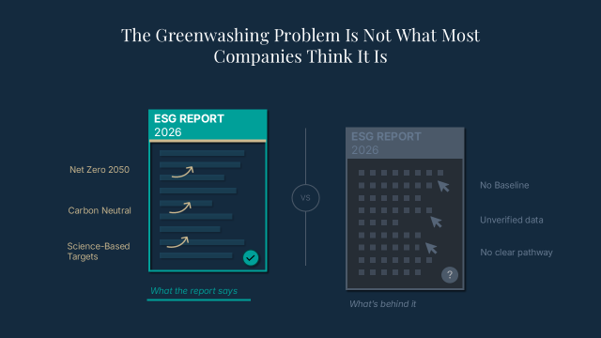
Most companies accused of greenwashing did not set out to mislead anyone. That is the part of the conversation that tends to get lost. The image most people have is of a company slapping a green leaf on its packaging while quietly doing the opposite, and that does exist. But the more common version looks nothing like that. It looks like a sustainability report that took months to prepare, was reviewed by multiple teams, and was aligned to a recognized framework. It still overstates what the company can actually demonstrate.
That version of greenwashing is less about intent and more about process; and for companies in the region starting to take ESG reporting seriously, understanding the difference matters.
The Gap Between Saying and Showing
The most straightforward way to think about greenwashing in an ESG context is the distance between what a company says in its report and what it can actually back up. A company publishes a net zero commitment with a target year; a few pages later, the emissions methodology either does not appear or is based on rough estimates that would not hold up under any real scrutiny. The commitment is in the document, but the foundation underneath it is not.
The same gap shows up in social disclosures. Workforce figures that quietly exclude contract employees, human rights commitments that apply only to direct suppliers, community investment numbers that group together very different types of spending to arrive at a more impressive total. None of these are necessarily deliberate choices, but they often reflect the way reporting has been structured internally, where the goal is to complete the disclosure rather than to test it.
Why Framework Alignment Is Not the Same as Credibility
There is a reasonable assumption that if a report is aligned to GRI, or references TCFD, or follows the SASB standards, it is credible by definition. The frameworks are rigorous, and the assumption is that using them produces rigorous output.
The issue is that frameworks tell companies what to report. They do not verify whether what is reported is accurate. A company can reference GRI standards throughout its sustainability report and still include figures that have never been checked, targets that have no real plan behind them, and qualitative statements that nobody inside the organization could actually operationalize. The framework alignment is genuine, but the report can still be misleading.
This is increasingly being recognized at the regulatory level. The direction in Europe, and to some extent in the United States, has been to move beyond requiring disclosure and toward requiring that disclosures be verifiable – The distinction is significant – It shifts the bar from publishing a report to being able to defend one.
For companies in Saudi Arabia and the wider GCC, this trajectory is relevant now. The CMA’s sustainability reporting expectations are developing, the GCC’s unified ESG metrics are in motion, and the anticipated shift toward mandatory disclosure will bring with it a higher expectation of substance. A well-presented report will be a starting point, not a finish line.
The Patterns Worth Watching
Greenwashing in ESG reporting tends to cluster around a few recognizable patterns, and they are worth understanding precisely because they do not require bad intent to appear.
The first is selective disclosure. Companies tend to report in more depth on the areas where they perform well, and address weaker areas more briefly. That is understandable, but it produces a picture that is systematically more positive than the full reality. An organization with a strong energy efficiency record and a more complicated story on water use will often dedicate pages to the former and a paragraph to the latter.
The second is targets without pathways. Long-term commitments to net zero or similar goals are increasingly common. What is less common is the near-term milestones, the capital plans, and the governance accountability that would make those commitments credible. A target without a mechanism is more of an aspiration than a plan, and over time that distinction becomes harder to maintain.
The third is boundary decisions that happen to produce better numbers. Companies have genuine choices about what is included in the scope of their reporting, and those choices can have a significant effect on the figures that result. Scope 3 emissions are the most visible example, but the same dynamic applies across social and governance disclosures. When the scope consistently excludes the areas of highest impact, that starts to be a problem regardless of how it is explained.
What Actually Reduces the Risk
Companies that are managing this well have generally done two things. First, they have taken the verification question seriously earlier in the process rather than treating it as a final check before publication. Data that has been collected with a defined methodology and can be traced back to its source is fundamentally different from data that was assembled to fill a reporting template.
Second, they have connected the sustainability report to the rest of how the business operates. When material issues identified in a report are owned by someone outside the sustainability team, tracked through operational targets, and visible in governance discussions, the report reflects something real; however, when it is produced by one team, the gap between the document and the business tends to grow over time.
Neither of these require a company to be more conservative about what it claims, but it requires the claims to be grounded.
What to Expect as Standards Evolve
Enforcement activity around greenwashing has been growing in Europe and the United States, and the logic behind it is fairly simple. As sustainability information becomes more material to investment and financing decisions, the accuracy of that information starts to matter in a way that attracts regulatory attention.
The regional picture is moving in the same direction. ESG-linked financing instruments are becoming more common, institutional investors are applying more structured ESG criteria, and the expectation around disclosure quality is rising. Companies that have already built the internal infrastructure to support credible reporting will be better placed when those expectations become requirements.
The more useful framing is not that greenwashing is a trap to avoid but that the discipline required to avoid it, accurate data, honest materiality, targets that are connected to real plans, is also what makes sustainability reporting genuinely useful to the organization. The companies that arrive at that point tend to have asked harder questions of their own process, not at the end of the reporting cycle, but throughout it.