
Innovation Ecosystem Design
Building Innovation Ecosystems That Fit
Why the next generation of ecosystem design starts with local conditions, not global templates
 Khawla Fal|
Saudi Arabia has assembled one of the most ambitious innovation infrastructure portfolios in the world. Accelerators, venture programmes, research centers, free zones, and giga-projects are creating a foundation that few emerging ecosystems can match. The scale and speed of this buildout is itself a statement of intent.
The next stage of this journey is a design question. As the Kingdom moves from building innovation assets to activating innovation ecosystems, the opportunity lies in designing models that draw their strength from local market dynamics. This is not a matter of surface-level localisation. It is a matter of engineering ecosystems around the specific conditions that make this market distinctive. The difference between an ecosystem that generates sustained value and one that remains a collection of standalone programmes often comes down to how well the underlying model reflects the environment it operates in.
What Makes Ecosystem Design Context-Specific
Innovation ecosystem models, whether accelerators, venture studios, innovation districts, or corporate venturing programmes, are built on assumptions about how value gets created and how innovation actors interact. These assumptions include how capital flows, how founders approach risk, how regulation shapes experimentation, and how talent moves between startups, corporates, and government to create the knowledge spillovers that make ecosystems self-reinforcing.
Every market has its own version of these dynamics. In the Gulf, capital flows through sovereign funds, family offices, and corporate balance sheets with distinct risk appetites and return horizons. Founders often operate within family business ecosystems where ownership, succession, and long-term reputation are central to decision-making. Regulation is evolving with purpose, emphasising national strategic outcomes and sustainable development. Talent mobility follows patterns shaped by nationalisation policies, public-sector career structures, and professional expectations that reflect the region’s own strengths.
These dynamics are not constraints to be worked around. They are design inputs. The most resilient innovation ecosystems in any market are the ones that treat local conditions as structural advantages and build models around them, rather than treating them as exceptions to a global norm.
When ecosystem models are designed with these inputs from the start, they produce stronger alignment between innovation actors, higher rates of sustained participation, and outcomes that compound over time. The opportunity is to build ecosystems that are durable precisely because they fit the market they serve. This is the shift from importing models to engineering them, and it represents the next frontier in how innovation infrastructure gets designed in high-ambition markets.
Three Design Principles for Locally-Rooted Ecosystems
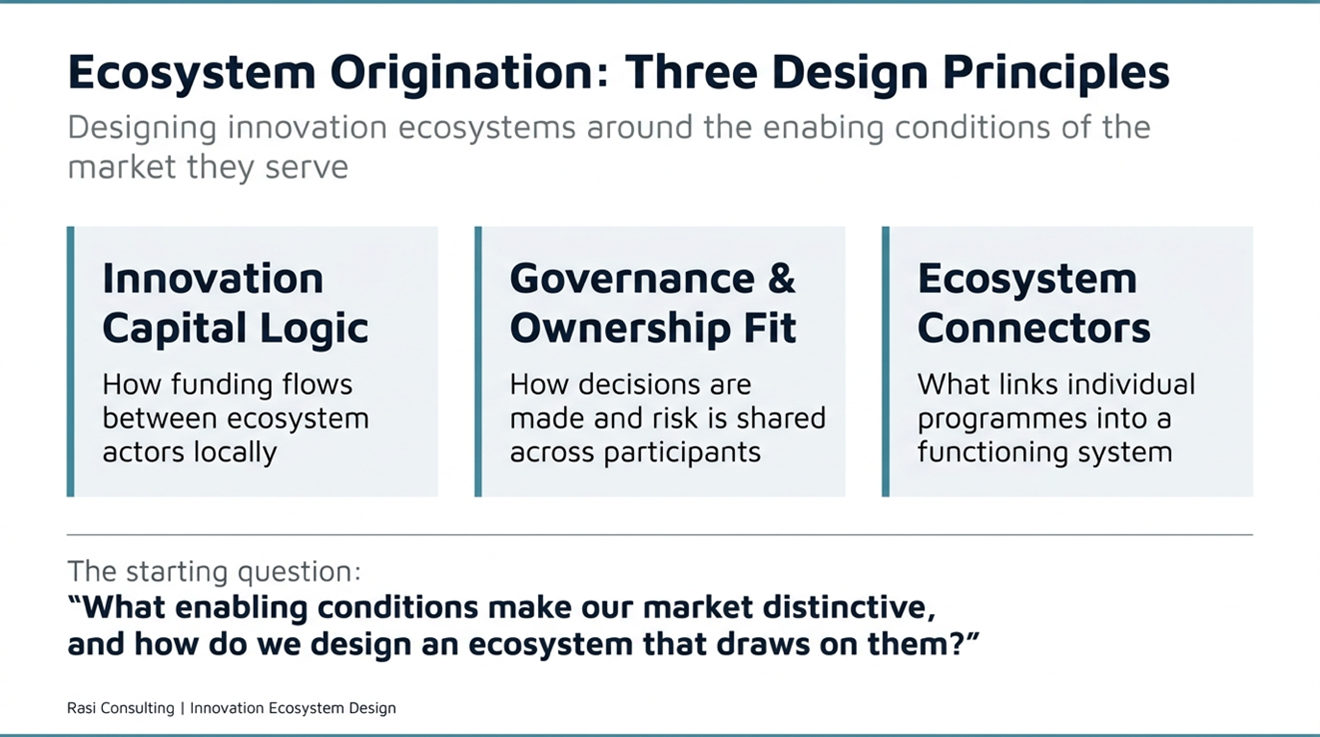
The strongest innovation ecosystems are engineered from the ground up around three structural realities that vary by market.
Innovation capital logic. Designing funding mechanisms that match how capital actually moves between ecosystem actors in this market. In Saudi Arabia, this means building for patient capital, corporate co-investment, and government-anchored funding structures. It means calibrating milestones and return expectations to the timelines that local investors operate on. When the funding architecture aligns with local capital behaviour, participation increases and ecosystem momentum builds organically.
Governance and ownership fit. Structuring programmes around the governance models that ecosystem participants actually use. In markets where family ownership, government mandates, and corporate diversification strategies intersect, ecosystem design benefits from accommodating these governance structures rather than simplifying them. Programmes that respect how decisions get made, how reputation is valued, and how ownership is structured attract stronger participation and deeper commitment from ecosystem actors.
Ecosystem connectors. Building the intermediary mechanisms that turn individual programmes into a functioning system: knowledge-sharing protocols, cross-institutional collaboration frameworks, shared talent pipelines, and regulatory sandboxes that enable experimentation with appropriate safeguards. These connectors are what transform a portfolio of innovation assets into a network where value circulates. Saudi Arabia has world-class innovation components. The opportunity now is to strengthen the connective tissue between them.
Monsha’at’s approach to SME enablement is a strong example of this design logic in practice. Its programmes were structured around gradual formalisation, practical capability building, and growth paths calibrated to how Saudi SMEs actually operate, creating enablement models that fit the market rather than asking the market to fit the model.
This same principle applies at every level of ecosystem design. Whether the focus is on deep-tech acceleration, corporate innovation programmes, or cross-sector collaboration platforms, the design question remains the same: what are the conditions this ecosystem must thrive within, and how do we engineer the model to draw strength from those conditions?
The Design Questions That Shape What Comes Next
For leaders building or scaling innovation ecosystem initiatives, whether inside a government entity, a corporate, or a development authority, three design questions shape the trajectory.
First, what are the enabling conditions this ecosystem will operate within? Understanding capital flows, governance patterns, talent dynamics, and regulatory architecture before selecting a model ensures the design starts from a position of strength. The most effective ecosystem leaders map these conditions with the same rigour they apply to market analysis, because the conditions are the market.
Second, which ecosystem connectors need to be in place before individual programmes scale? Shared standards, knowledge infrastructure, and collaboration protocols create the network effects that turn a portfolio of programmes into a self-reinforcing system. Building connectors early is one of the highest-leverage investments an ecosystem leader can make, because connectors multiply the value of every component they link.
Third, how will the ecosystem measure its health over time? The most useful indicators track network density, knowledge circulation, and sustained participation, not just programme outputs. Ecosystems that measure connections alongside components are better positioned to adapt, learn, and grow with the market they serve.
The most productive innovation ecosystems in the world are not the ones that adopted the most recognised models. They are the ones that built models uniquely suited to their own conditions, models that others eventually want to learn from. Saudi Arabia’s innovation infrastructure is positioned to become exactly that.